Tax Basis Tracking for Multi-Member LLC Owners
A profitable LLC can still create an unpleasant tax surprise when an owner takes cash without knowing their basis. Tax basis tracking shows how much each member can generally receive or deduct before different tax results may apply.
For a multi-member LLC taxed as a partnership, the business reports activity on Form 1065 and issues a Schedule K-1 to each member. Yet each owner's outside basis belongs in a separate record. A shared spreadsheet total is not enough.
Start with the distinction between the LLC's books and each member's tax position.
Why Each LLC Member Needs a Separate Basis Record
Outside basis is a member's tax basis in their ownership interest. It begins with what that member contributed and changes over time with tax allocations, distributions, and their share of partnership liabilities.
Two owners may each hold 50% of an LLC but have very different basis. One may have contributed more cash. Another may have received larger distributions. A member's basis can also differ because of debt allocations under the partnership tax rules.
Ownership percentage does not set basis
Ownership percentage often controls voting rights and profit-sharing, but it doesn't automatically determine tax basis. A 50% owner who contributes $80,000 starts in a different place than a 50% owner who contributes $20,000.
The operating agreement, contribution records, general ledger, debt agreements, and tax return must tell the same story. When they do not, resolving the difference later can take far more work.
Basis affects more than distributions
A member's outside basis can limit the partnership losses they deduct on their individual return. It also helps determine whether a cash distribution creates taxable gain.
The IRS explains that a distribution may be taxable when it exceeds the member's adjusted basis immediately before the distribution. Review the IRS partnership distribution guidance when evaluating an unusual payment or large year-end withdrawal.
Tax Basis Tracking Is Different From Other LLC Balances
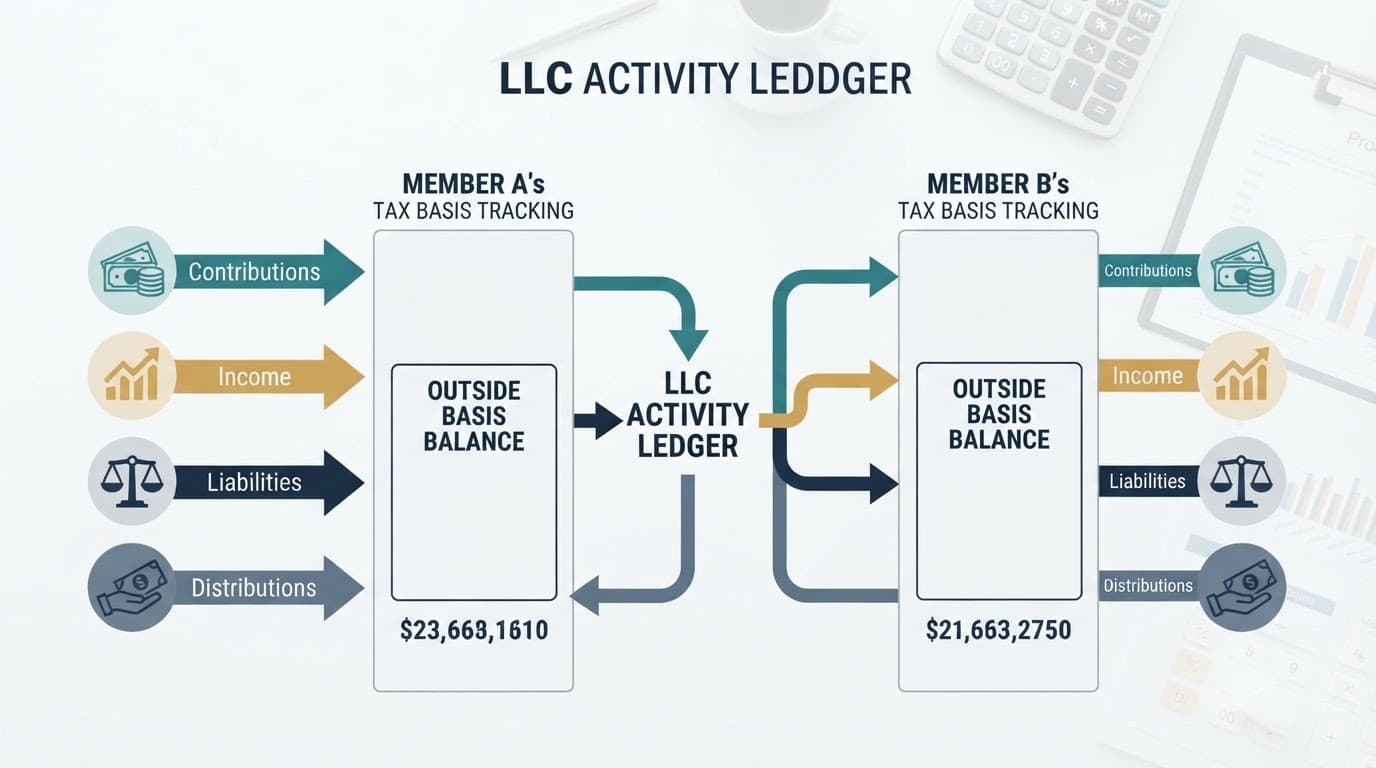
Several reports use the word "capital," which can cause costly confusion. Outside basis is related to those figures, but it is not interchangeable with them.
| Amount | What it measures | Why it may differ from outside basis |
|---|---|---|
| Ownership percentage | Economic and voting rights | It does not record each owner's tax history |
| Book capital account | Equity shown in company books | Book income and tax income can differ |
| Tax-basis capital on K-1 | Tax capital account reported for the member | It excludes partnership liabilities |
| Asset basis | The LLC's tax basis in its assets | It belongs to the LLC, not the member |
| Outside basis | Member's tax basis in the LLC interest | It includes relevant liability allocations |
The IRS Schedule K-1 instructions identify tax-basis capital reporting in Item L and liability information in Item K. Those items are useful inputs, but neither one alone gives the full outside-basis answer. See the current IRS Schedule K-1 instructions for the reporting framework.
Book capital can be useful, but it is not the answer
Your balance sheet should track member contributions, distributions, and equity by owner. That work supports clean records. However, book capital may use financial accounting entries that do not match tax reporting.
For example, depreciation on the books may differ from tax depreciation. Guaranteed payments also affect the partnership return differently than a cash distribution. Treat the capital accounts as a starting point, then reconcile them to tax records.
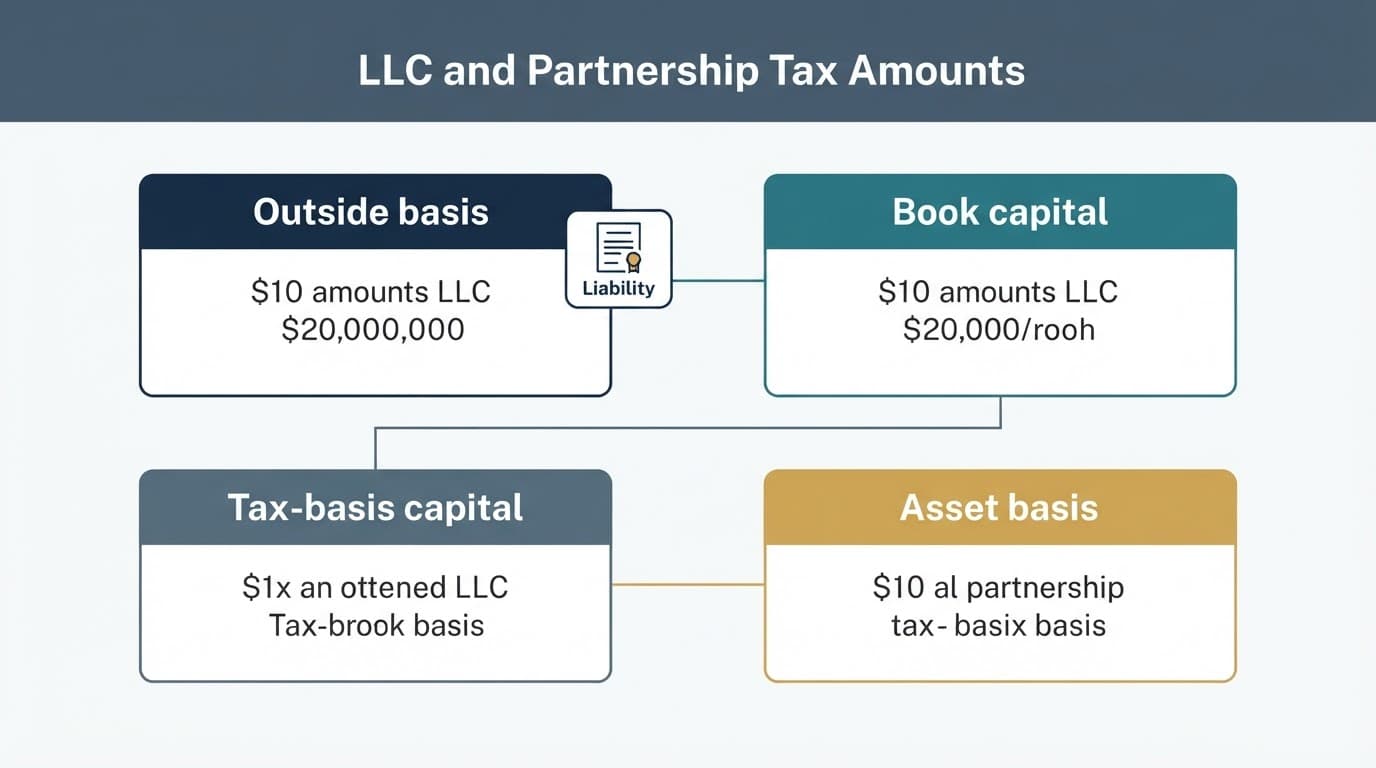
Establish Each Member's Opening Outside Basis
A sound basis schedule starts before the current year. Pull the prior-year workpapers, filed K-1s, contribution records, debt schedules, and any ownership-transfer documents.
For a new LLC, a member's opening basis generally starts with cash contributed plus the adjusted tax basis of property contributed. The tax basis of a contributed truck, equipment, or real estate interest may differ sharply from its current market value.
Document property contributions carefully
Keep a signed contribution agreement for noncash property. It should identify the asset, contribution date, contributor, adjusted tax basis, any debt attached to the property, and supporting records.
A property contribution can involve special rules. If the LLC assumes debt or the member's share of liabilities changes, that may affect outside basis. Avoid recording contributed property at an estimated value in the basis schedule without tax review.
Recover missing history before guessing
A prior preparer's file may contain a partner basis worksheet, Schedule K-1 attachments, or depreciation schedules that resolve a missing opening balance. If records are incomplete, rebuild the schedule from source documents and identify the assumptions in writing.
General ledger equity alone cannot reliably recreate outside basis. This guide provides general educational information, not individualized tax advice. A tax professional should review a reconstructed basis schedule before you rely on it for a loss deduction, major distribution, sale, or ownership change.
Use a Consistent Annual Basis Formula
A basis schedule should show every adjustment by member and by date. The basic calculation is straightforward, even though the details can become technical.
Outside basis is a member-level tax number. The LLC can have one set of books, but every member needs a separate tax-basis history.
Use this working formula for each member:
Beginning outside basis
+ Cash and adjusted-basis property contributed
+ Allocated taxable and tax-exempt income
+ Increase in the member's share of partnership liabilities
- Cash and property distributions
- Allocated losses, deductions, and applicable nondeductible expenses
- Decrease in the member's share of partnership liabilities
= Ending outside basis
Preserve the order of adjustments
The order can matter when a member receives distributions and also has allocated income or losses. For example, income generally increases basis before losses reduce the amount that may be deductible.
Your tax preparer may use a more detailed worksheet for separately stated items, credits, nondeductible expenses, section 754 adjustments, and other special facts. The formula is a recordkeeping framework, not a substitute for a completed tax analysis.
Record Contributions and Member Advances Correctly
Cash deposits do not automatically increase basis. The entry depends on what the payment actually is. It may be a capital contribution, a loan from a member, repayment of an expense, or revenue.
Label each transfer when it happens. A vague memo such as "owner money" creates questions at tax time.
Separate contributions from loans
A capital contribution increases the contributing member's outside basis. A bona fide loan from a member to the LLC follows a different path. It may affect the member's tax position, but it should appear in a loan payable account with a note, repayment terms, and supporting documentation.
Likewise, don't post a member's personal payment of an LLC bill to income. Record the business expense and offset it to the appropriate member contribution or payable account.
For practical account setup, review this guide to recording owner contributions and withdrawals. Member-level equity accounts make year-end reconciliation much cleaner.
Keep contribution support with the schedule
For every contribution, retain the bank record, journal entry, date, owner name, amount, and description. For property, retain the original purchase documents and prior depreciation records.
If one member contributes cash to cover a shortfall, do not split that amount evenly among all owners. The contribution belongs to the member who made it unless a documented agreement says otherwise.
Add Income and Track Loss Limits by Member
Members owe tax on their allocated share of partnership income, even if the LLC retains cash for payroll, inventory, rent, or growth. That allocated income usually increases the member's outside basis.
A distribution, by contrast, usually reduces basis. It is not a measure of profit. This distinction matters when an LLC has a strong year but holds cash, or has a weak year while owners withdraw funds.
Use every relevant K-1 item
Do not rely only on ordinary business income in Box 1. Separately stated items can affect basis too. Depending on the LLC's activity, this may include interest income, capital gains, section 179 deductions, charitable contributions, tax-exempt income, and nondeductible expenses.
Retain the complete K-1 package and supporting statements. The IRS outside-basis practice unit describes beginning tax-basis capital and liability shares as starting points for estimating outside basis.
Suspended losses need their own record
A K-1 loss is not always currently deductible. Basis, at-risk, and passive activity rules can each limit the deduction. If a member cannot deduct a loss, keep a schedule that identifies the amount, tax year, and reason it was suspended.
Do not erase a suspended loss because it was not claimed this year. It may become deductible later when the member has enough basis and meets the other requirements.
Treat Distributions as a Tax Event, Not a Casual Draw
An LLC member may call a payment a draw, owner withdrawal, distribution, advance, or reimbursement. The label in QuickBooks does not settle the tax treatment.
Cash distributions generally reduce the member's outside basis dollar for dollar. Property distributions require more analysis because tax basis, fair market value, debt, and asset type can all matter.
Watch distributions that exceed basis
Suppose a member has $12,000 of outside basis immediately before receiving a $16,000 cash distribution. The excess may trigger taxable gain under the partnership distribution rules.
Do not wait until the annual return is prepared to check this. Review larger distributions quarterly, especially if the LLC has debt changes, losses, or uneven owner withdrawals.
Distinguish distributions from guaranteed payments
A guaranteed payment is compensation-like payment from the partnership to a member. It generally appears on the partnership return and Schedule K-1 differently from a distribution.
Because the treatment differs, record these payments separately from member distributions. For more detail, see the firm's guide to partner guaranteed payments.
Include Partnership Liabilities in the Basis Schedule
Partnership liabilities are one reason outside basis often exceeds tax-basis capital reported on the K-1. A member's share of LLC debt can increase their outside basis, while a decrease in that share can reduce it.
The rules distinguish recourse, nonrecourse, and qualified nonrecourse financing. Allocation can depend on the operating agreement, guarantees, economic risk, property, and other facts.
Debt refinancing can change basis without cash changing hands
An LLC can refinance a loan, pay off a line of credit, admit a member, or change guarantees. The bank balance may look ordinary, while each member's share of debt changes.
A reduction in a member's share of partnership liabilities can be treated as a deemed cash distribution for tax purposes. That reduction belongs in the basis schedule even though no deposit reaches the member's bank account.
Request the liability allocation details with the year-end K-1 package. Do not assume the owners' percentage split always matches their tax allocation of every debt.
Work Through a Simple Two-Member Example
Assume Sunrise Services LLC has two equal members, Ana and Blake. At the start of the year, Ana has outside basis of $30,000. Blake has outside basis of $45,000 because Blake previously contributed more cash.
During the year, Ana contributes another $10,000. She receives $18,000 of allocated ordinary income, takes a $22,000 cash distribution, and her share of partnership liabilities increases by $5,000.
Ana's year-end basis calculation is:
| Ana's basis calculation | Amount |
|---|---|
| Beginning outside basis | $30,000 |
| Cash contribution | +$10,000 |
| Allocated income | +$18,000 |
| Increase in liability share | +$5,000 |
| Cash distribution | -$22,000 |
| Ending outside basis | $41,000 |
Her ownership percentage remained 50%, yet her basis moved from $30,000 to $41,000. Blake needs a separate schedule based on Blake's own contributions, K-1 allocations, distributions, and debt share.
This example leaves out property contributions, losses, credits, nondeductible expenses, and special tax elections. Those items can change the calculation.
Complete an Annual Reconciliation Before Filing
Tax basis tracking works best as a year-round habit, followed by a formal reconciliation after the books close. The reconciliation should tie together bookkeeping records, debt information, tax workpapers, and every owner's K-1.
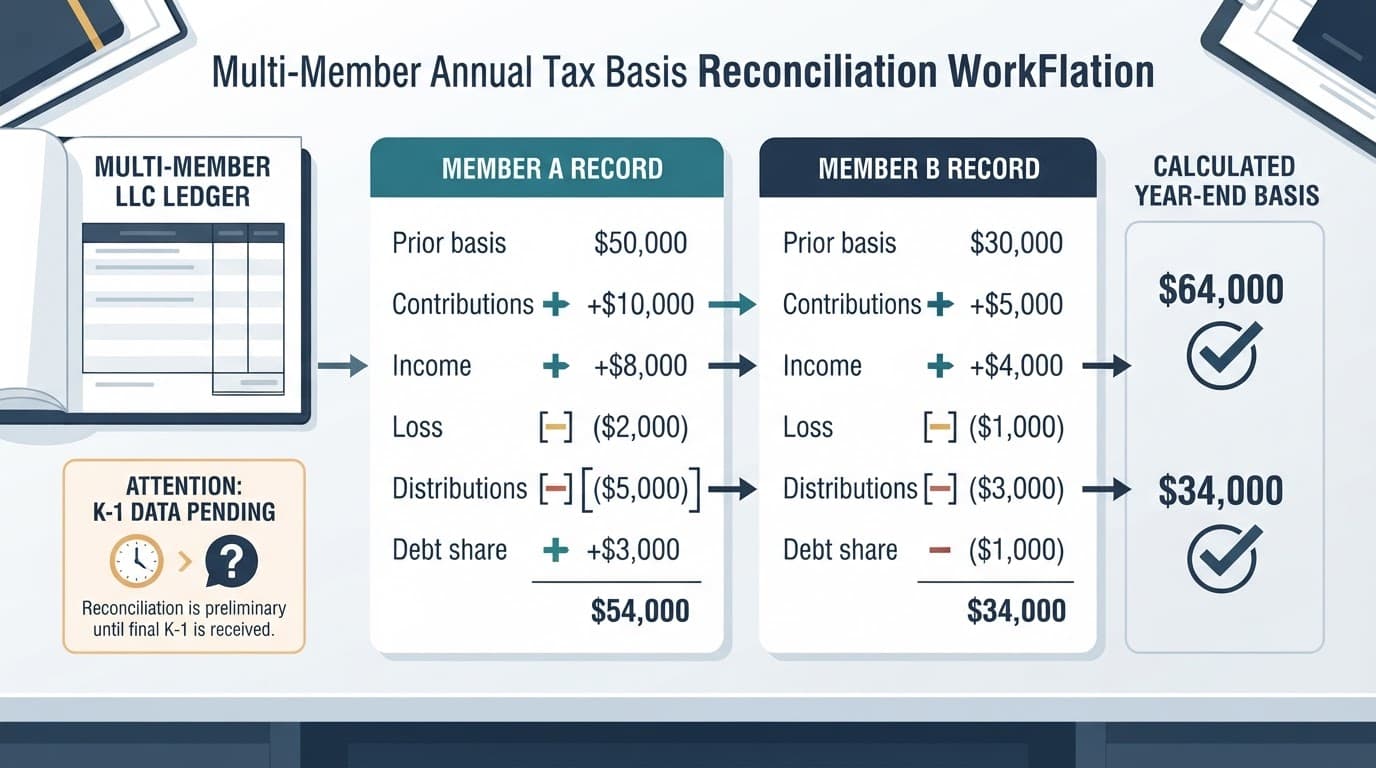
Use this year-end review checklist
- Confirm each member's beginning outside basis against the prior year's final basis schedule.
- Match each member's recorded contributions and distributions to bank activity, equity accounts, meeting minutes, and written approvals.
- Review the full Schedule K-1 and all attached statements for income, deductions, tax-exempt income, nondeductible items, and separately stated amounts.
- Compare beginning and ending partnership liabilities, then document each member's allocated share.
- Reconcile tax-basis capital in K-1 Item L without treating it as the member's full outside basis.
- Carry forward any suspended losses and retain the supporting calculation with the tax file.
- Obtain advice before reporting a basis-sensitive transaction on an individual tax return.
A dependable bookkeeping system makes this review faster. The firm's Form 1065 basics for LLC partnerships explains how the partnership return and member K-1s fit together.
Red Flags That Call for Prompt Review
Basis problems often begin with a routine business event that was never flagged for the tax file. Addressing it before a distribution, return filing, or sale gives you more options.
Watch for these warning signs
- A member takes more cash than their current basis schedule supports.
- Basis turns negative or changes sharply without a clear transaction.
- The tax preparer receives incomplete K-1 statements or no liability allocation detail.
- The LLC refinances debt, pays down a large loan, or changes personal guarantees.
- An owner joins, exits, transfers an interest, dies, divorces, or sells part of their membership interest.
- The LLC changes its federal tax classification, such as electing S corporation treatment.
- The operating agreement changes profit, loss, or distribution provisions.
- The books combine all member contributions and distributions in one generic equity account.
A change in tax classification requires special care because partnership outside basis rules do not simply carry over as a bookkeeping label. Review the available Florida LLC tax classification options before making an election or altering owner compensation practices.
Final Thoughts
A member's tax basis is a running record, not a year-end guess. Separate schedules, timely documentation, and careful debt tracking help prevent distributions, losses, and ownership changes from becoming filing-season surprises.
The strongest habit is simple: update each member's outside basis whenever money, property, taxable income, losses, distributions, or debt allocations change.