Florida Corporate Estimated Tax Payments: A 2026 Guide
A profitable Florida C corporation can owe state tax long before its annual return is due. If your business expects more than $2,500 of tax for the year, Florida corporate estimated tax payments usually belong on your calendar.
The rules differ from federal estimated taxes, and the due dates can surprise even experienced business owners. A clear forecast, clean books, and timely installments can prevent a year-end cash crunch and avoidable underpayment charges.
Florida corporate estimated tax: who must pay?
Florida imposes corporate income/franchise tax on corporations that do business, derive income, or exist in the state. The standard corporate tax rate is 5.5% of Florida net income after applicable adjustments and exemptions.
A corporation generally must make estimated payments when it reasonably expects its Florida corporate income tax liability to exceed $2,500 for the taxable year. The business uses Form F-1120ES, Declaration/Installment of Florida Estimated Income/Franchise Tax .
Entities commonly subject to the tax
Florida C corporations are the most common filers. An LLC that elected federal taxation as a C corporation can also fall under Florida's corporate income tax rules.
A corporation formed outside Florida may have a filing obligation if it conducts business or earns Florida-source income. Florida S corporations are generally exempt, although an S corporation can owe Florida corporate income tax in limited situations where federal law imposes corporate-level tax.
By contrast, a single-member LLC taxed as a disregarded entity and a partnership-taxed LLC don't pay Florida corporate income tax merely because they operate here. Their owners may still owe federal estimated taxes, sales tax, reemployment tax, or tax in another state. Review the entity election before setting an estimated-tax schedule, especially if ownership or tax status changed during the year.
The $50,000 exemption matters
Florida generally provides a $50,000 exemption against Florida net income. That exemption can keep a smaller corporation below the estimated-payment threshold, but it doesn't remove the need to forecast profit.
For example, if a corporation projects $180,000 of Florida net income after state adjustments, the taxable amount may be $130,000 after the exemption. At 5.5%, the projected tax is $7,150 before credits. Because that exceeds $2,500, estimated installments are required.
Calculate the year's expected corporate tax
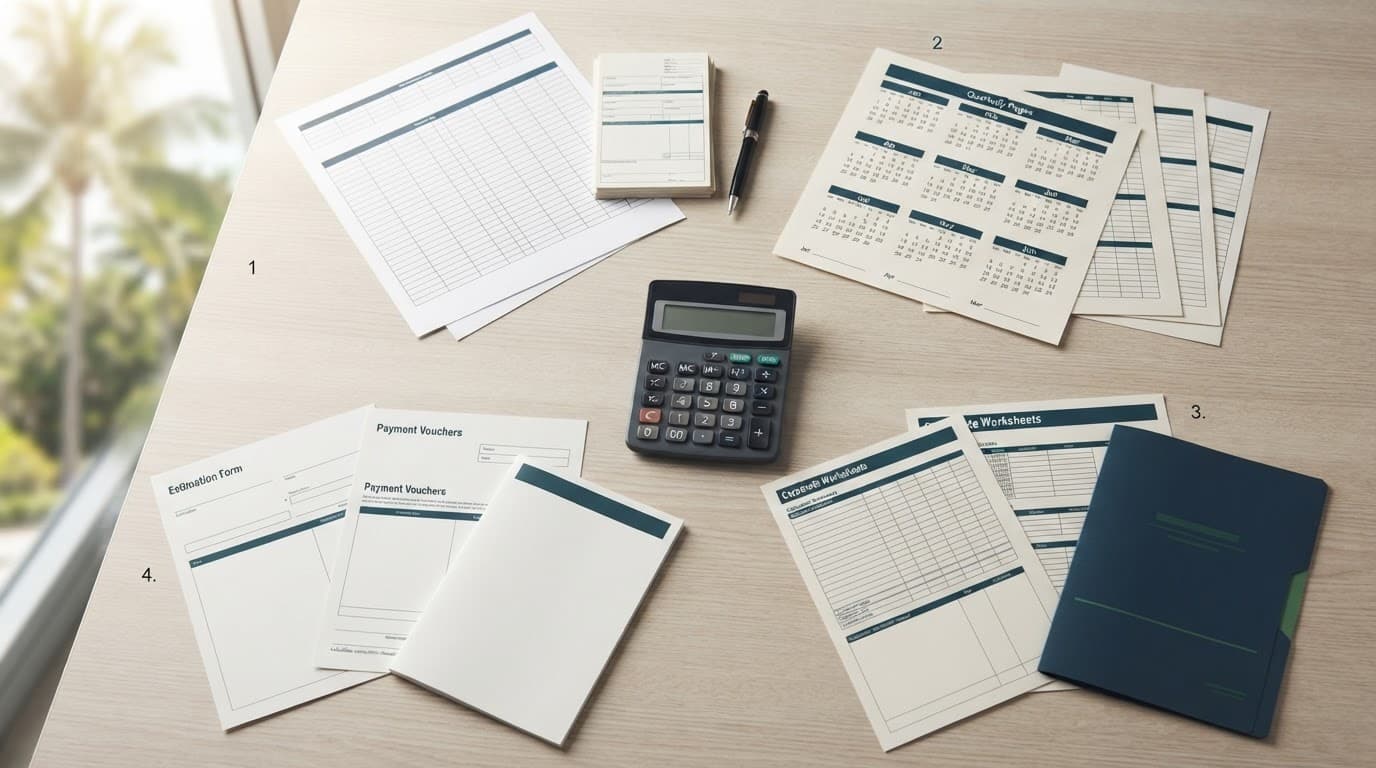
Estimated payments work best when they come from current financial records, not last-minute guesses. Start with a year-to-date profit and loss statement, then revise the forecast as sales, payroll, depreciation, and major expenses change.
Build an estimate from your books
Use this practical sequence:
- Project full-year book income using actual results through the latest closed month.
- Identify expected federal taxable-income adjustments, including depreciation and timing differences.
- Apply Florida additions, subtractions, and the corporate exemption where they apply.
- Multiply estimated Florida taxable income by 5.5%.
- Subtract eligible Florida tax credits and compare the result with the $2,500 threshold.
- Divide the expected tax into the required installments, generally four equal 25% payments.
Using the earlier $7,150 example, a straightforward four-installment plan is $1,787.50 per payment. However, a new contract, asset sale, credit, or loss late in the year can change that number. Update the calculation before each due date.
Credits can change the payment amount
A corporation may qualify for Florida credits, including credits related to approved contributions or incentive programs. Credits often have application requirements, caps, and timing rules. Don't reduce estimated payments for a credit until you can document that the business qualifies and can use it.
Keep a separate workpaper showing the estimate, expected credits, prior payments, and the documents behind each figure. That file makes Form F-1120 preparation much easier and supports your position if Florida questions the calculation.
For a closer look at annual filing requirements, review this Florida corporate income tax guide.
Florida corporate estimated tax deadlines for 2026
Florida uses its own installment dates. For a calendar-year corporation, payments are due on the following schedule.
| Installment | Calendar-year 2026 due date | Typical payment |
|---|---|---|
| First | May 31, 2026 | 25% |
| Second | June 30, 2026 | 25% |
| Third | September 30, 2026 | 25% |
| Fourth | December 31, 2026 | 25% |
The dates are based on the corporation's taxable year, not the calendar date when management finishes the forecast.

Fiscal-year filers need a separate calendar
For tax years ending other than June 30, installments are generally due on the last day of the fifth, sixth, and ninth months of the taxable year, plus the last day of the tax year.
A corporation with a September 30 year-end would generally use February 28 or 29, March 31, June 30, and September 30. Since the schedule follows the tax year, some due dates may fall in the preceding calendar year.
A June 30 year-end uses a different pattern. Payments are due on the last day of the fourth, sixth, and ninth months, then on the final day of the tax year. For a year ending June 30, 2026, the due dates are October 31, 2025; December 31, 2025; March 31, 2026; and June 30, 2026.
A fiscal-year corporation should set its payment calendar when the tax year begins, not when the annual return comes due.
Short tax years require extra care
A new corporation, a final return, or a change in accounting period can create a short taxable year. Regular installment assumptions may not fit that situation. In addition, the prior-year safe harbor requires a prior taxable year of 12 months.
Review the current Form F-1120ES instructions and discuss short-year calculations with a qualified tax professional before sending payments.
File Form F-1120ES and document every payment
Use Form F-1120ES to declare and pay Florida estimated income/franchise tax. Florida permits electronic filing and payment through its corporate tax system. Businesses that pay electronically should save the confirmation number, payment date, amount, and tax period with their tax records.
Paper filing may still be available under current Department of Revenue procedures, but electronic payment creates a clearer record. Don't rely on a bank statement alone, since it may not identify the tax period or payment type.
Keep a payment file that ties to the return
Your year-end preparer needs more than total payments. Keep copies of each F-1120ES filing or electronic confirmation, along with the forecast supporting the installment amount.
Also retain:
- Year-to-date and final profit and loss statements
- General ledger detail for large income and expense changes
- Prior-year Florida Form F-1120 and payment records
- Credit approvals, contribution receipts, and carryforward schedules
- Florida notices and proof of responses
Accurate bookkeeping keeps these records within reach. A C corporation tax return checklist can help organize the documents before the annual filing deadline.
Prior-year safe harbor and underpayment penalties
Florida's estimated-tax rules look at each installment. Paying the full amount late doesn't erase the earlier shortfall. The Department of Revenue can charge a 12% annual penalty on an underpayment, calculated for the days the amount remained unpaid. Interest also applies at the rate set under Florida law.
Form F-2220 calculates underpayment charges for Florida corporate income/franchise tax. The usual required-payment test begins with 90% of the tax shown on the current-year return, then compares each required installment with what the corporation actually paid by that due date.
When prior-year tax can protect you
A prior-year method may reduce or eliminate underpayment charges if the corporation's preceding taxable year was a full 12 months and it filed a return for that year. The comparison has detailed conditions, so it isn't a blanket permission to pay whatever the business owed last year.
This option can help a company with an unexpected income increase. Still, a major acquisition, sale, tax credit, or change in entity status can affect the result. Use the current Form F-2220 instructions before relying on a safe harbor.
Late payments need a prompt correction
If you discover a missed installment, pay the shortage as soon as possible. A later payment stops additional penalty and interest from building after the payment date, but it generally doesn't rewrite the original due date.
Don't assume an extension for Form F-1120 extends estimated-tax due dates. A calendar-year Florida corporate return is generally due May 1, but the fourth estimated payment was due the prior December 31.
Federal estimates and Florida payments are separate
Florida has no personal income tax, yet that fact doesn't eliminate federal tax obligations. Corporate federal income tax and Florida corporate income/franchise tax use separate forms, rates, calculations, payment systems, and due dates.
For federal filing details, use the IRS page for Form 1120 information and updates. Federal calendar-year corporate estimated payments generally follow a different pattern, with due dates in April, June, September, and December. Confirm those dates in the IRS 2026 tax calendar.
Don't confuse owner taxes with corporate taxes
A shareholder or LLC owner may need federal estimated income tax payments even when the business owes no Florida corporate income tax. The IRS estimated-tax payment guidance applies to individuals, not to Florida corporate installments.
That difference matters when an S corporation pays officer wages, distributes profit, or has owners with income from several states. For entity-specific help, review Florida tax considerations for S corps and partnerships.
Handle overpayments on the annual return
Estimated payments are prepayments of the tax reported on Florida Form F-1120. If payments exceed the final liability, the corporation generally addresses the overpayment on that return. It may request a refund or apply the amount to a future tax period, subject to the return instructions and any outstanding state liabilities.
Applying an overpayment to the next year's estimates can preserve cash planning flexibility. However, don't count on a projected refund to cover an installment before the Department processes the return. Track the credit election and confirm it appears on the next year's estimated-tax workpaper.
Keep Florida corporate tax payments predictable
Florida corporate estimated tax is manageable when the company forecasts taxable income, applies the 5.5% rate correctly, and follows the installment schedule tied to its tax year. The $2,500 threshold, tax-year end, and prior-year filing history all affect the plan.
Clean monthly books turn estimated payments into a routine financial task instead of a year-end surprise. Verify current forms and procedures with the Florida Department of Revenue or a qualified tax professional before filing.