
Construction WIP Accounting for Small Contractors
A job can have money in the bank and still be losing profit. That happens when invoices, job costs, and the latest estimate don't tell the same story.
Construction WIP accounting gives small contractors a monthly view of work completed, costs incurred, revenue earned, and amounts billed. It helps owners catch a fading margin before the project is finished and the loss is permanent.
A useful WIP report starts with clean job-cost records and an honest forecast to complete each active project.
What construction WIP accounting tells you about each job
Work in progress, or WIP, measures the financial position of projects that are still open. Unlike a basic profit and loss report, it looks at individual contracts rather than the business as one large bucket.
Good construction WIP accounting compares actual results with the most current expectation for each job. It answers whether the company has earned more or less revenue than it has billed.
A project can look busy while its margin disappears
A signed contract price doesn't protect profit. Material price increases, extra subcontractor hours, rework, weather delays, and missed change orders can shrink the margin quickly.
For example, a remodel may be 40% complete based on cost, yet the crew may have used 55% of the labor budget. A monthly WIP review puts that gap in front of the owner while there is still time to adjust scheduling, pricing, or job scope.

WIP is a management report before it becomes an accounting entry
A WIP schedule is not a substitute for the general ledger, customer invoices, or tax return. Instead, it ties those records together so you can review a job's current status.
Most small contractors prepare WIP monthly. Firms with large projects, thin margins, or frequent progress billings may need a review twice a month. The report should use the same cut-off date as the financial statements.
Start with job-cost records you can trust
The math in a WIP schedule is simple. The hard part is feeding it complete and current information.
Every direct cost needs a job name and a cost category. Crew time, payroll burden, materials, subcontractors, permits, equipment rentals, disposal fees, and job-specific travel should land in the correct project record. General office rent and company-wide insurance usually belong in overhead unless your accounting policy allocates them to jobs.
QuickBooks Online job costing for contractors can help create a consistent trail for purchases, time, bills, and customer charges.
Record costs when they belong to the work period
A vendor invoice that arrives late can distort the report if it relates to work already completed. At month-end, ask project managers about unrecorded subcontractor work, delivered materials, and outstanding equipment charges.
Then record an accrual when appropriate under your accounting process. The goal is to show contract-to-date costs , not only bills that happened to arrive before the month closed.
Replace the bid estimate with the current forecast
Your original estimate is useful history, but it isn't a forecast. The WIP schedule needs the latest estimated total cost, which includes costs already incurred plus the realistic cost to finish.
Review remaining labor hours, open purchase orders, subcontractor commitments, permit delays, and approved changes. If a job's projected cost rises from $360,000 to $400,000, update the forecast immediately. Waiting until the final invoice only hides the problem.
A WIP schedule becomes unreliable when its cost-to-complete figure still reflects the original bid after field conditions have changed.
Build a construction WIP accounting schedule
A basic WIP schedule uses a cost-to-cost calculation. It measures job progress by comparing actual costs incurred with the latest estimated total cost.
Use one row per active contract. Keep approved change orders in the revised contract value, and track pending changes separately until your company and accounting adviser agree they belong in recognized revenue.
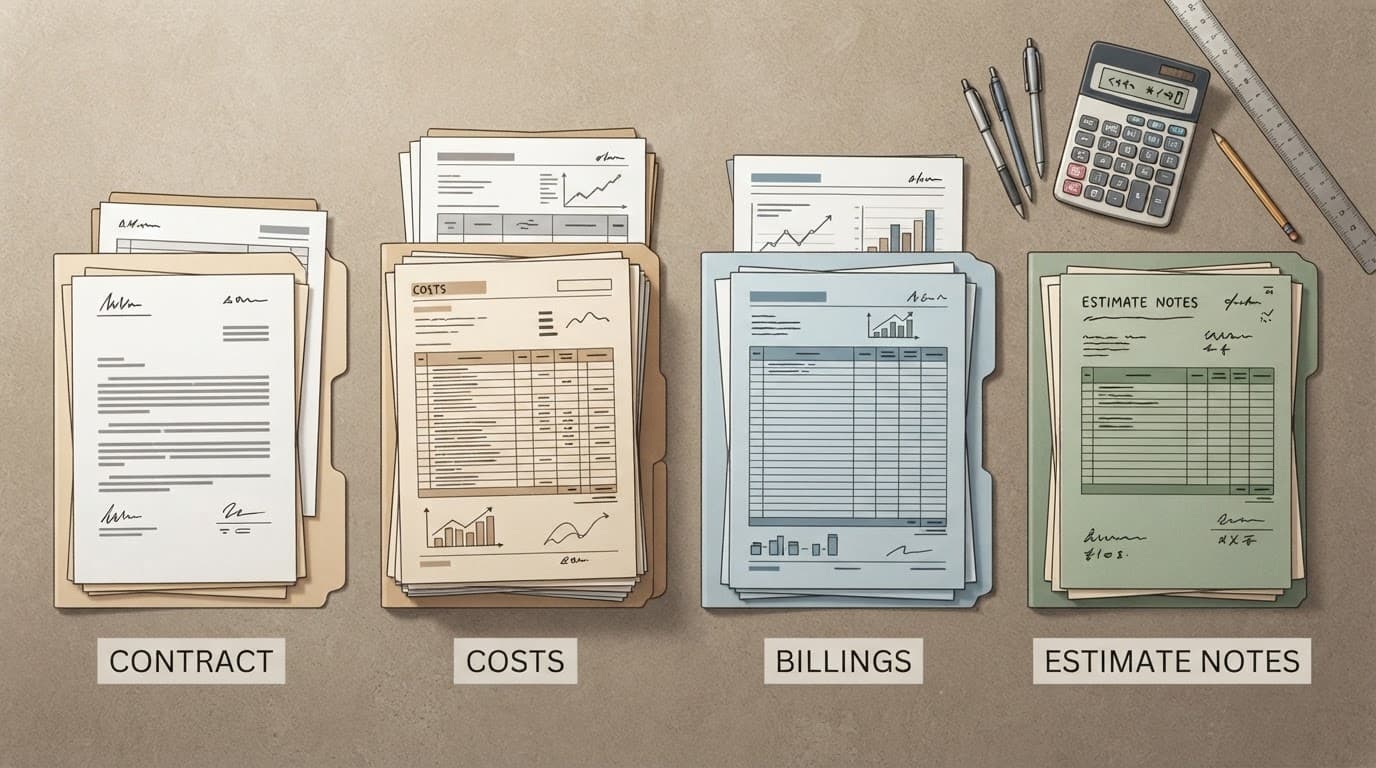
The core formulas to use each month
These figures give an office manager a practical starting point:
| WIP item | Formula | Example |
|---|---|---|
| Percentage complete | Contract-to-date costs / estimated total costs | $160,000 / $400,000 = 40% |
| Earned revenue | Current contract value x percentage complete | $500,000 x 40% = $200,000 |
| Earned gross profit | Earned revenue - contract-to-date costs | $200,000 - $160,000 = $40,000 |
| Estimated job profit | Current contract value - estimated total costs | $500,000 - $400,000 = $100,000 |
| WIP position | Billings to date - earned revenue | $230,000 - $200,000 = $30,000 overbilled |
In this example, the job is 40% complete and has earned $200,000 in revenue. Because the company has billed $230,000, it has a $30,000 overbilling position.
Use the revised contract value, not a stale number
Contract value should include the original signed price plus approved change orders. A verbal approval, a disputed extra, or a likely future change may be real in the field, but it needs separate tracking until it is supported.
Likewise, don't remove expected costs because a subcontractor has not sent the final bill. Forecasts work only when both sides of the job, revenue and cost, stay current.
Read overbillings and underbillings correctly
An overbilling occurs when billings to date are greater than earned revenue. An underbilling occurs when earned revenue exceeds billings to date.
Neither one is automatically good or bad. A deposit, early material draw, or milestone invoice can create an overbilling that supports payroll and supplier payments. However, a large overbilling can also mean the job has used too much of the customer's cash before enough work is complete.
Underbillings often point to a billing or paperwork issue
An underbilling can occur when crews complete work but the office has not issued a progress invoice. It can also result from unsigned change orders, delayed inspections, missing time entries, or retainage.
Progress billing for construction projects should follow the same estimate and job record used in the WIP schedule. If billing comes from a different spreadsheet, mismatches will pile up.
Keep retainage separate from earned revenue
Retainage is money withheld under the contract, usually until a milestone or closeout requirement is met. It affects cash collection, but it doesn't change the amount of revenue earned by itself.
Track customer retainage due and subcontractor retainage owed by job. Clear construction retainage accounting prevents a project from appearing healthier than it is because a large receivable remains tied up.
Follow a monthly WIP review routine
Set a monthly deadline that gives the field team time to report progress and the office time to enter costs. A regular process matters more than a complicated template.
A practical five-step close
- Close the job-cost period after entering time, bills, credit card purchases, and customer invoices through the reporting date.
- Ask each project manager for a revised cost-to-complete estimate and the status of change orders.
- Update contract values, total estimated costs, billings to date, and actual contract-to-date costs.
- Calculate percentage complete, earned revenue, gross profit, and the overbilling or underbilling position.
- Review major changes with the owner, then post any needed financial statement entries under your bookkeeper's or CPA's direction.
Keep a copy of each month's schedule. Comparing the current report with prior months reveals whether margin is holding steady or slipping.
Investigate margin changes, not only large jobs
A small job can cause a large percentage loss. Set a review threshold for jobs with declining estimated profit, costs above budget, or billings that lag completed work.
For each exception, identify the cause in plain language. It may be an estimating miss, unapproved extra work, late vendor cost, labor overrun, or customer dispute. That record helps the next bid as much as it helps the current job.
Separate financial WIP from tax method decisions
Your internal WIP report helps run the business, but it does not decide your tax method. Tax treatment can vary by contract type, expected completion period, entity facts, and the accounting method already in use.
The IRS generally requires the percentage-of-completion method for certain long-term construction contracts. The agency's construction contract accounting regulations describe cost-to-cost calculations and the rules that apply to those contracts.
Small-contractor exceptions need a contract-by-contract review
A contractor may qualify for an exception to mandatory percentage-of-completion treatment when a contract is expected to finish within two years and the business meets the average annual gross receipts test. For 2026, the indexed gross-receipts threshold is $32 million.
That test can involve prior-year receipts and related businesses, so don't rely on a quick sales total. Home construction contracts have separate considerations, and the IRS discussion of the home construction exception shows why contract classification matters.
Ask a CPA before changing methods
Completed-contract, percentage-of-completion, and other permitted methods can produce different timing for taxable income. A method that worked for a smaller contractor may need review as revenue grows or contract terms change.
Some long-term contracts also trigger look-back calculations after completion. The IRS Form 8697 instructions explain when that filing applies. A qualified CPA should confirm the proper tax method, any required accounting-method change, and whether WIP adjustments belong in your financial statements.
Keep WIP useful as your company grows
Construction WIP accounting works when the field and office share the same facts. The estimator, project manager, bookkeeper, and owner don't need identical tasks, but they do need one current view of contract value, incurred costs, remaining costs, and billings.
Review each open job before the month closes. Current estimates turn WIP from a backward-looking report into a practical way to protect the profit you expected when you won the work.