Profit vs Cash Flow: Why Cash Is Falling
A business can report its strongest month of profit and still struggle to cover payroll. Sales may be recorded before customers pay, while inventory, loan principal, taxes, and supplier bills consume cash today.
That is the practical lesson of profit vs cash flow . Profit shows what the business earned after recognized expenses. Cash flow shows what entered and left the bank. Comparing both turns a confusing cash shortage into a working-capital issue you can investigate and manage.
Profit vs cash flow: two reports, two questions
Profit answers, "Did the business earn money during this period?" It appears on the income statement, where revenue is matched with recognized expenses. The result can be positive even when little cash has reached the bank.
Cash flow answers, "What happened to the money available to the business?" It tracks customer collections, vendor payments, payroll, taxes, loan payments, equipment purchases, and owner withdrawals.
The difference often comes from your accounting method. Under the cash method, businesses generally report income when they receive payment and deduct expenses when they pay them. Under the accrual method, income is generally reported when earned, while expenses are recorded when incurred. The IRS guide to accounting periods and methods explains these timing rules.
Your accounting method affects the appearance of monthly profit, but neither method removes the need to watch the bank balance. A business using accrual accounting may show a profitable sale in March even though the customer won't pay until April.
Accounts receivable, inventory, accounts payable, and debt are the bridge between profit and cash. A cash versus accrual accounting explanation for small businesses can help owners understand why the same activity looks different across financial reports.
Why cash falls when profit rises
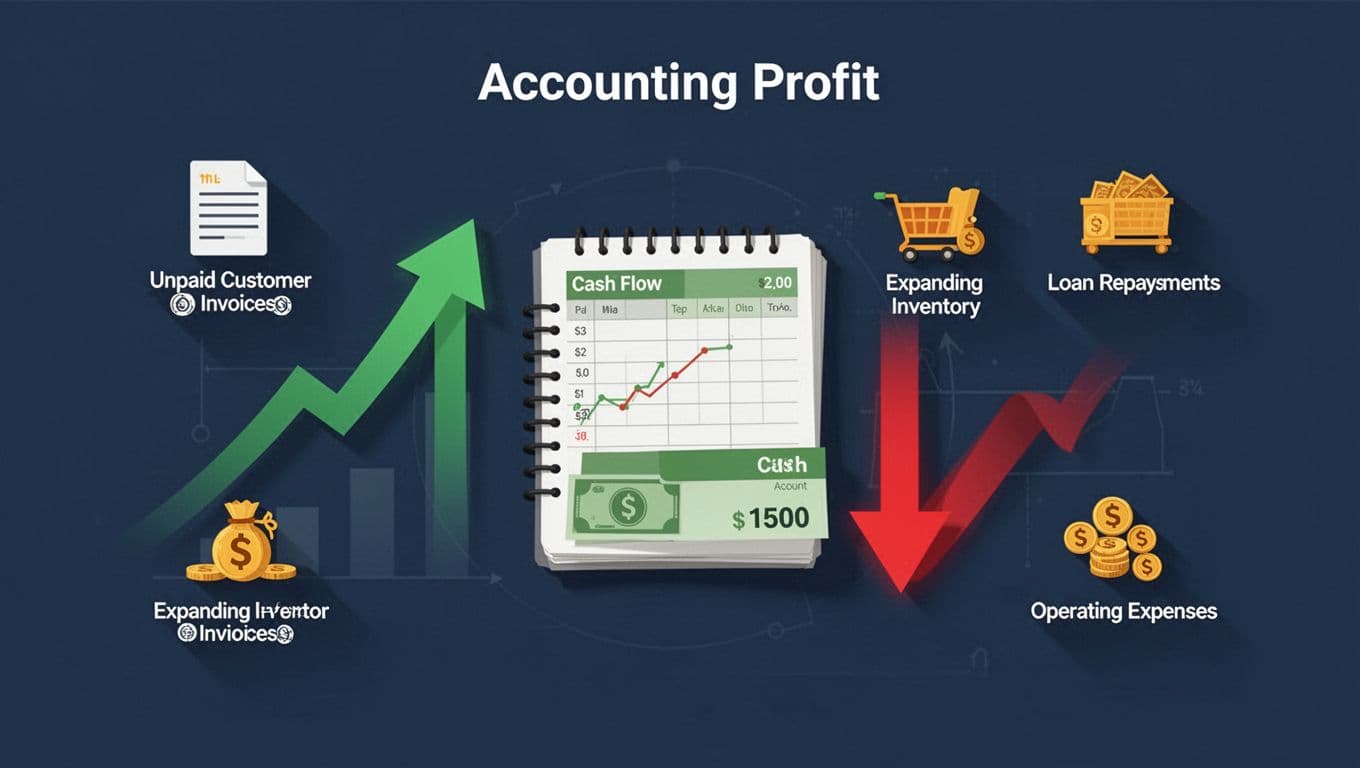
A profitable business can face a cash shortage for several ordinary reasons. The issue often involves timing or working capital, rather than an accounting mistake.
Customers owe you money
Suppose you complete $30,000 of work and send an invoice with 45-day payment terms. Accrual accounting may include that $30,000 in current revenue. Your bank account, however, doesn't increase until the customer pays.
As unpaid invoices grow, accounts receivable can absorb more cash than the business generates. Review your accounts receivable aging report each month. Pay close attention to invoices past due, large balances from one customer, and work that hasn't been billed.
Faster invoicing, deposits, milestone payments, and consistent collection follow-up can shorten the gap between earning revenue and receiving cash.
Inventory uses cash before it becomes an expense
Retailers, contractors, restaurants, and manufacturers often buy inventory before selling it. The purchase reduces cash immediately, but accounting records may hold the cost as an asset until the inventory is sold.
That timing can make profit look healthy while cash declines. A growing stockroom isn't automatically good news if products move slowly or purchases exceed current demand. Compare inventory on hand with recent sales and upcoming orders before placing another large order.
Loan principal reduces cash without reducing profit
Loan payments contain interest and principal. Interest usually appears as an expense on the income statement. Principal reduces the loan balance, but it generally doesn't reduce accounting profit.
As a result, a business can show a strong net income figure while making substantial debt payments each month. Equipment purchases create a similar difference. The cash leaves when you buy the asset, while depreciation spreads the expense across future periods.
Owner draws and distributions also reduce cash. They don't usually appear as business expenses on the income statement, so they can be easy to overlook when reviewing profitability.
Taxes and unpaid bills change the timing
Payroll taxes, sales taxes, and income tax payments can take cash out of the business after the related sales or payroll activity has already appeared in the books. Those amounts may sit as liabilities until payment is due.
The opposite can also happen with supplier bills. If you receive materials or services but haven't paid the invoice, profit may include the expense while cash remains temporarily higher. That cash can disappear later when several bills become due at once.
A profit report can improve while the bank account worsens when customers pay later than the business pays suppliers and lenders.
Example: February profit rises while cash declines
Consider a small business that starts January with $20,000 in cash. Its February sales increase, but collections lag and several cash payments arrive together.
| Month | Revenue recognized | Expenses recognized | Profit | Cash movement | Ending cash |
|---|---|---|---|---|---|
| January | $40,000 | $32,000 | $8,000 | +$8,000 | $28,000 |
| February | $60,000 | $42,000 | $18,000 | -$12,000 | $16,000 |
February profit rises by $10,000, yet ending cash falls by $12,000.
The February revenue includes a $25,000 customer invoice that remains unpaid. The business collects $35,000 during the month. It pays $30,000 in operating costs, buys $12,000 of inventory, and pays $5,000 toward loan principal.
The $42,000 of recognized expenses includes $4,000 of depreciation and $8,000 in supplier bills that remain unpaid at month-end. The inventory purchase has not all become an expense because the business hasn't sold all of that inventory. The loan principal is a cash payment, but it isn't an income statement expense.
Nothing in this example requires an error. The business is profitable, but its cash is tied up in receivables and inventory. It also has commitments that profit alone doesn't show.
This is why owners should review profit vs cash flow together. The income statement measures performance. The balance sheet shows what is tied up in receivables, inventory, and unpaid bills. The cash flow statement explains the movement in available funds.
Month-end review checklist for falling cash
A rising profit report deserves a cash review before you make new hiring, purchasing, or expansion decisions. Start with a bank reconciliation so your reports use complete and accurate transactions. This monthly QuickBooks bank reconciliation checklist covers common issues such as deposits in transit, bank fees, transfers, and processor payouts.

Use this month-end review checklist
- Reconcile every bank and credit-card account through the last day of the month. Investigate old unreconciled items instead of carrying them forward.
- Review accounts receivable by customer and age. Contact customers with overdue balances and confirm that completed work has been invoiced.
- Compare inventory purchases with sales activity. Identify slow-moving stock, duplicate orders, and deposits paid for materials that haven't arrived.
- List unpaid vendor bills with their due dates. Add the expected payments to next month's cash plan.
- Separate loan principal from interest. Confirm that each payment is recorded against the correct accounts.
- Check payroll tax, sales tax, and income tax liabilities. Set aside cash for payments that are due soon.
- Review owner draws, distributions, and personal expenses paid from business accounts. These payments reduce available cash even when profit remains unchanged.
- Compare the income statement with the balance sheet and cash flow statement. Look for large changes in receivables, payables, inventory, loans, and cash.
- Check for duplicate transactions, missing deposits, incorrectly categorized transfers, and timing errors around month-end.
If the bank reconciliation is clean and the reports still show rising profit with falling cash, the gap is probably operational. A cash flow statement preparation service can help tie the income statement, balance sheet, and cash activity together.
How to protect cash as profit grows
Start by improving collection timing. Send invoices as soon as work reaches a billable point, request deposits for large jobs, and set payment terms that match your suppliers' terms. A customer who pays in 60 days creates pressure when your vendors require payment in 15 days.
Next, build a rolling cash forecast. A simple forecast lists expected collections, payroll, rent, taxes, loan payments, inventory purchases, and other known obligations by week. A small business cash flow forecasting guide can help you organize those figures.
Set a minimum cash balance based on fixed monthly obligations. When projected cash drops below that level, delay nonessential purchases, adjust inventory orders, collect past-due invoices, or discuss financing before the shortage becomes urgent.
Keep tax and payroll funds separate when possible. Treat collected sales tax and withheld payroll taxes as money owed to a government agency, not as operating cash. The IRS Tax Guide for Small Business provides guidance on income, expenses, and accounting methods, but your bookkeeping should also show when those obligations will be paid.
Finally, review the forecast against actual results each month. A forecast becomes useful when you learn why collections, expenses, and payment dates differed from expectations.
Conclusion
Profit and cash answer different financial questions. Profit can rise when sales are recorded before collection, inventory absorbs funds, loan principal comes due, or taxes and owner payments reduce the bank balance.
Review receivables, inventory, payables, debt, taxes, and reconciliations at month-end. When the records are accurate, falling cash usually points to timing or working capital that needs attention. Profit matters, but cash keeps the business operating.