Fort Myers QBI Deduction Guide for LLCs and S Corps in 2026
A tax break that looks simple on paper can get messy fast once an LLC or S corp enters the picture. For many Fort Myers owners, the goal is plain: keep more of the profit the business earns.
The QBI deduction can do that, but only when the entity, payroll, and income limits line up. If you're comparing LLC and S corp treatment, the details matter more than the label on the business card.
Florida has no state income tax, but the QBI deduction is a federal income tax rule.
What the QBI deduction means for Fort Myers business owners
The qualified business income deduction, also called the Section 199A deduction, can let eligible owners deduct up to 20% of qualified business income. It applies to many pass-through businesses, including sole proprietorships, partnerships, LLCs, and S corporations.
This is not a Florida deduction. It shows up on your federal return, usually through IRS Form 8995 or, for more complex cases, Form 8995-A.
For 2025 returns filed in 2026, the 2025 Form 8995 instructions show the simplified form applies when taxable income before the QBI deduction is at or below $197,300 for single filers and $394,600 for joint filers. Above that, wage limits, property limits, and service business rules can start to bite.
As of March 2026, current federal law keeps the deduction in place beyond 2025, so it's still part of smart entity planning this year.
If you're still sorting out how your business is taxed, start with Fort Myers single-member LLC tax basics. The IRS tax classification, not just the LLC paperwork, drives the QBI result.
LLC vs. S corp, where the QBI math changes
The real QBI deduction LLC S corp comparison is less about the entity name and more about how income flows to your return. Two businesses can earn the same profit and still get very different QBI results.
An LLC taxed as a sole proprietorship usually counts net Schedule C profit as QBI. An S corp works differently. The owner who works in the business usually must take a salary, and that salary is not QBI.

This quick comparison helps:
| Topic | LLC taxed as sole prop or partnership | S corporation |
|---|---|---|
| Owner pay | Usually no W-2 to owner | Working owner usually needs W-2 wages |
| What may count as QBI | Net business profit | Pass-through profit, not shareholder wages |
| Payroll effect | No owner wage base from default setup | W-2 wages can help once income is high |
| Main trade-off | Simpler, but more income may face self-employment tax | More admin, but possible payroll tax planning |
The big S corp catch is reasonable salary . Pay yourself too little, and the IRS can reclassify distributions as wages. Pay yourself too much, and you shrink the profit left for QBI. That's why Fort Myers reasonable compensation for S corp owners matters so much.
In short, an S corp can help overall tax planning, but it does not automatically create a bigger QBI deduction.
Real-world examples that show the trade-offs
Service business example
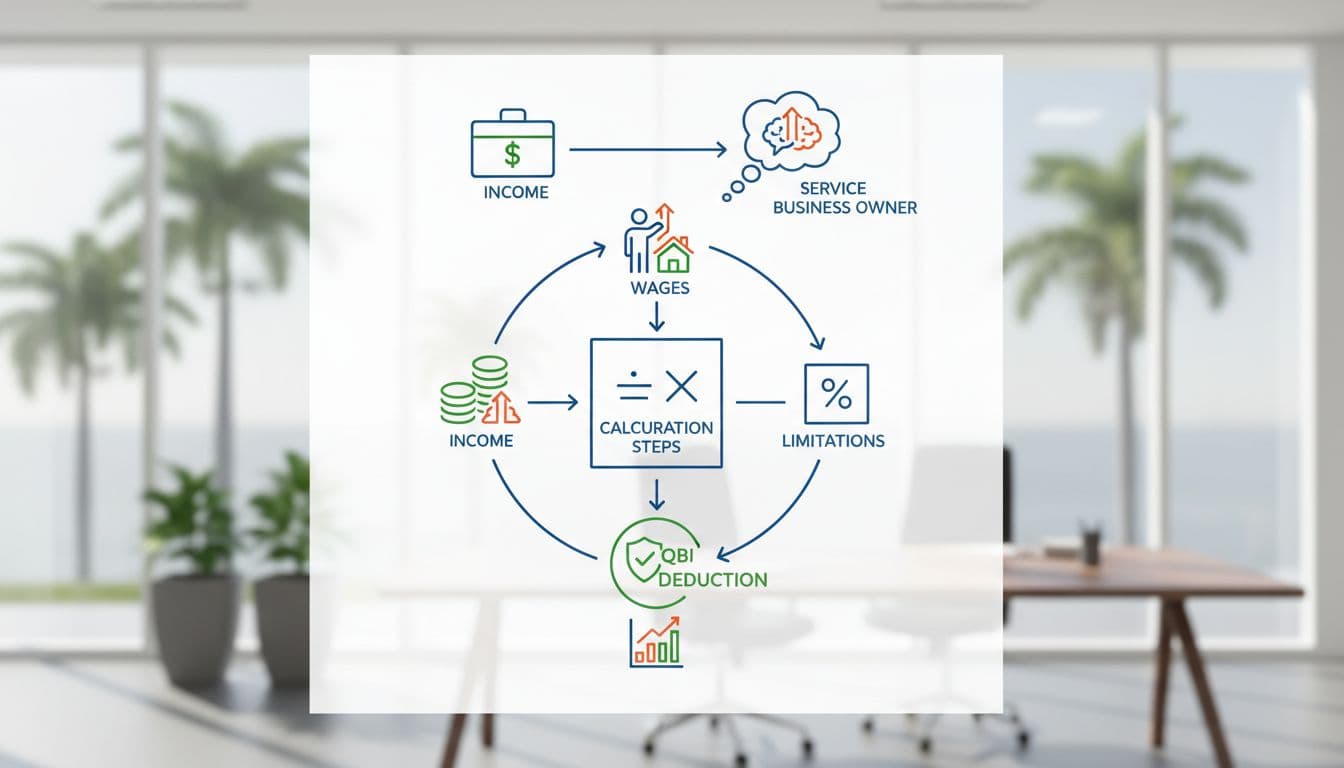
Say a Fort Myers marketing consultant runs a single-member LLC and shows $120,000 of net profit. If taxable income stays under the IRS threshold, up to $24,000 may qualify as a QBI deduction.
Now picture the same owner electing S corp status. The business earns $120,000 before owner pay, and the owner takes a $70,000 reasonable salary. That leaves $50,000 of pass-through profit. In that case, the wage is not QBI, so only the $50,000 profit enters the QBI calculation, which could mean up to a $10,000 deduction.
That sounds worse, but it isn't the full story. The S corp may still reduce payroll taxes overall. QBI is just one part of the decision.
Service businesses also face another twist. Consulting, health, law, accounting, and similar fields are often specified service trades or businesses. Once taxable income rises above the phase-in range, the deduction can shrink or disappear. Recent 2026 law changes widened those ranges, so more higher-income owners may still qualify, but the numbers need a fresh review each year.
Non-service business example
Now take a Fort Myers pool equipment distributor with $300,000 of qualified income, employees on payroll, and business equipment. Because this is generally not a service business, the deduction can still survive at higher income levels. Here, W-2 wages and qualified property may help support the deduction when income crosses the standard threshold.
That is where an S corp can sometimes look better on paper. Even though owner wages don't count as QBI, business wages may help with the wage limit.
If you're an S corp owner paying expenses personally, don't forget reimbursements. A clean Fort Myers accountable plan for S corps and LLCs can keep those write-offs where they belong and prevent messy year-end adjustments.
Common mistakes that cost owners money
A few errors show up again and again in Fort Myers tax planning:
- Treating QBI like a Florida deduction : It isn't. Florida's no-income-tax status doesn't change the federal rules.
- Counting S corp wages as QBI : Wages paid to the owner reduce pass-through profit for QBI purposes.
- Ignoring service business limits : High-income consultants and other service firms can lose the deduction faster than non-service businesses.
- Picking an entity for QBI alone : A better QBI result can still be the wrong move if payroll, compliance, and total tax costs work against you.
Bottom line for LLCs and S corps
The QBI deduction can be a real tax saver, but it works best when the entity choice fits the business, not when the business is forced to fit a tax shortcut. For Fort Myers owners, the key issues are taxable income, service-business status, payroll, and how much pass-through profit remains after owner compensation. Before you elect S corp status or reset owner pay, talk with a qualified tax professional who can review your facts. This article is general information, not tax advice.