Fort Myers Home Office Deduction Guide For Self-Employed Owners
Working from home in Fort Myers can feel normal now. You answer client emails before breakfast, prep invoices after dinner, and squeeze calls between school pickup and traffic on McGregor.
The home office deduction can reward that routine, but only if you follow strict IRS rules. This guide covers who qualifies, how to choose a method, and the real-life "gray areas" that trip up Southwest Florida business owners.
Florida's twist is simple: there's no Florida personal income tax , so the benefit is mainly on your federal return. The rules are still the same IRS rules, whether you're in Fort Myers, Cape Coral, or anywhere else.
What counts as a qualifying home office (and what doesn't)
The IRS starts with two big tests: exclusive use and regular use . Exclusive means the space is used only for business, not sometimes, not "mostly." A guest room that doubles as an office usually fails. A spare bedroom that's only an office usually passes. The IRS lays this out in Publication 587, Business Use of Your Home.
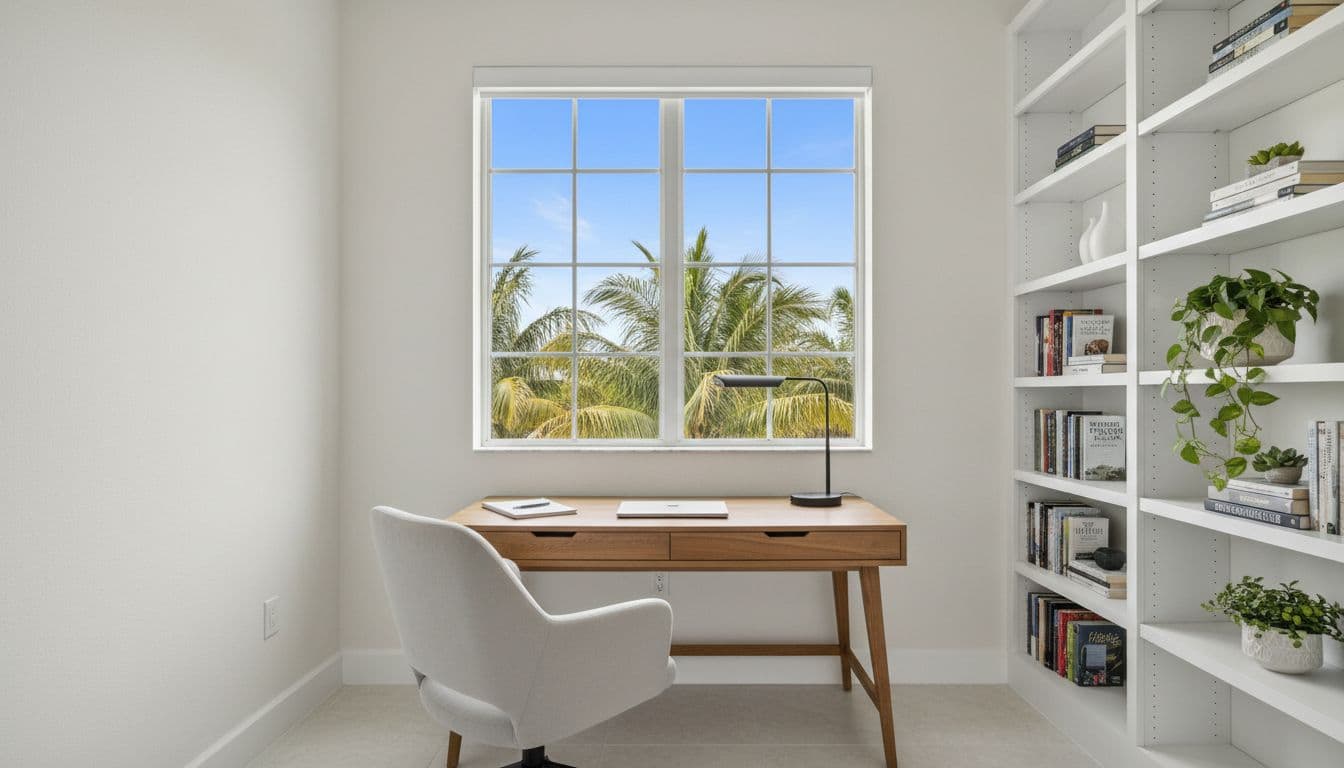
Next is principal place of business . That doesn't always mean "where you earn money." If you do admin and management tasks at home (billing, scheduling, planning) and you don't have another fixed location for those tasks, home can still qualify even if you do field work elsewhere.
A few Fort Myers-style examples help:
- Real estate agent : Showing homes all over Lee County, but running the business from a dedicated home office can qualify.
- Mobile contractor : Job sites change daily, but a defined home office for estimates, permits, and bookkeeping can qualify.
- Salon suite renter : If you already have a fixed office location where you manage the business, the home office claim is harder.
If you can't honestly say "no personal use," don't claim the space as exclusive. The IRS cares more about facts than good intentions.
Also, this deduction is generally for self-employed filers (most often on Schedule C). If you're a W-2 employee working from home, you can't take the home office deduction under current federal rules for this filing season.
If you run your business as a sole proprietor or single-member LLC, the deduction usually flows through Schedule C. For how that connects to the rest of your return, see Schedule C filing for Fort Myers LLC owners.
Simplified vs actual expenses: choose the method that fits your records
You can compute the home office deduction using either the simplified method or actual expenses . Many owners pick based on recordkeeping, not math, then regret it later. Think of it like choosing between a flat rate and itemizing your receipt: one is easier, one can be larger.

Here's the quick comparison most Fort Myers self-employed owners need:
| Feature | Simplified method | Actual expense method (Form 8829) |
|---|---|---|
| How it's calculated | $5 per sq ft, up to 300 sq ft | Business % of real home costs |
| Max deduction | $1,500 | Depends on expenses and limits |
| Depreciation | None | Yes (for homeowners) |
| Carryover if limited | No | Yes, allowed in many cases |
| Recordkeeping | Light | Heavier (bills, allocation, support) |
With the simplified method , you multiply business-use square footage by $5, capped at 300 square feet (max $1,500). It's clean and fast. However, you can't carry over an excess amount if your business income limits the deduction.
With actual expenses , you generally measure your office area as a percentage of the home (square footage is common). Then you apply that percentage to eligible costs. Indirect costs can include utilities, homeowners insurance, rent, mortgage interest, property taxes, HOA fees (when tied to the home), and general repairs. Direct costs that only benefit the office (like painting the office) can be fully deductible. The IRS covers these categories and limits in the Instructions for Form 8829.
One more timing detail matters: you choose the method each year on the original return . Once you file for that year, you generally can't switch methods later for that same year.
Mixed-use rooms, detached spaces, daycare rules, and depreciation recapture
Real homes aren't perfect rectangles, and real businesses spill into family space. The IRS rules still expect clean lines.
Mixed-use rooms (the "corner desk" problem)
If you work in a bedroom corner, the biggest risk is exclusive use. A simple fix is to make the business area unmistakable: a defined section, separate storage, and no personal items. Still, if the room is a guest room or a child's room, you're pushing uphill.
Separate structures (garage office, backyard studio, ADU)
A detached garage office or backyard studio can qualify if it's used exclusively and regularly for business and it's used in connection with your business. This setup is common in Fort Myers, where owners convert a garage bay or create a small workspace off the main house.
Daycare and inventory exceptions
Two exceptions come up often:
- Daycare providers can claim certain home expenses even without full exclusive use, but the calculation is special and often based on both space and time.
- Storage of inventory or product samples can qualify even if the area isn't exclusive, when you meet the IRS conditions (for example, your home is the only fixed location of that business).
These are detail-heavy areas, so it's worth reading the IRS rules in Publication 587 before you claim them.
Depreciation recapture when you sell your home
Here's the long-term "gotcha." If you use the actual method as a homeowner, you may claim depreciation on the business-use portion of your home. Later, when you sell, that depreciation can trigger recapture (often taxed up to 25%), even if the rest of your home sale qualifies for the home sale exclusion.
The simplified method avoids home office depreciation, which is one reason many owners stick with it, even when the deduction is smaller.
The paperwork that makes the deduction feel safe
Before you file, use this short checklist:
- Measure office square footage, keep a sketch or notes.
- Take dated photos showing business-only use.
- Save mortgage interest, rent, tax, insurance, and utility statements (actual method).
- Track repairs, separate office-only repairs from whole-home repairs.
- Keep your business income and expenses clean on Schedule C (see the Schedule C instructions).
- Document any partial-year business use if the office started mid-year.
- If you're an S-corp owner on payroll, ask about an accountable plan instead of a Schedule C home office claim.
Conclusion
A home office can be a real deduction, not a myth, when the space is truly business-only and well documented. Start by confirming you meet the exclusive and principal place rules, then pick the method you can support with records. When you plan ahead, the home office deduction feels like a normal part of your return, not a risky afterthought.
General information only, not tax advice. Tax results depend on your facts, and IRS rules can change. Talk with a tax professional about your specific situation before filing.