Fort Myers 1099 Vs W-2 Rules For Small Business Owners
Hiring help in Fort Myers can feel simple until paperwork starts. The hard part is that 1099 vs W-2 is not a choice you and the worker make together. It turns on the real working relationship.
As of March 2026, the IRS still uses its long-running common-law test. The U.S. Department of Labor proposed a new rule in February 2026, but it is not final, and it would not replace IRS tax rules or Florida reemployment tax rules. For small business owners, the safest approach is simple: look at the facts, not the title, contract, or preference.
What actually decides 1099 vs W-2 status
A signed contractor agreement can help show intent. Still, it does not control the outcome by itself. If you treat someone like staff day after day, a contract calling them an independent contractor will not fix that.
The IRS looks at three big areas in its worker classification guidance. First is behavioral control . Do you decide when, where, and how the work is done? Do you train the person or require detailed procedures? The more control you keep, the more the role looks like W-2 employment.
Second is financial control . Contractors usually have their own tools, their own business costs, and some chance of profit or loss. Employees usually depend on the business to provide the job, the systems, and the steady paycheck.
Third is the relationship itself. Benefits, long-term open-ended work, and work that sits at the center of your business can point toward employee status. An LLC, business card, or higher hourly rate does not automatically make someone a contractor either.

A simple way to think about it is this: if the worker runs their own business, they may be a contractor. If they mainly work inside your business, they may be an employee.
What the worker wants matters less than how the job actually works.
A simple 1099 vs W-2 comparison for Fort Myers employers
Many owners flip the logic. They think, "I'll pay by 1099, so the person is a contractor." It works the other way around. First decide the status, then issue the right form.
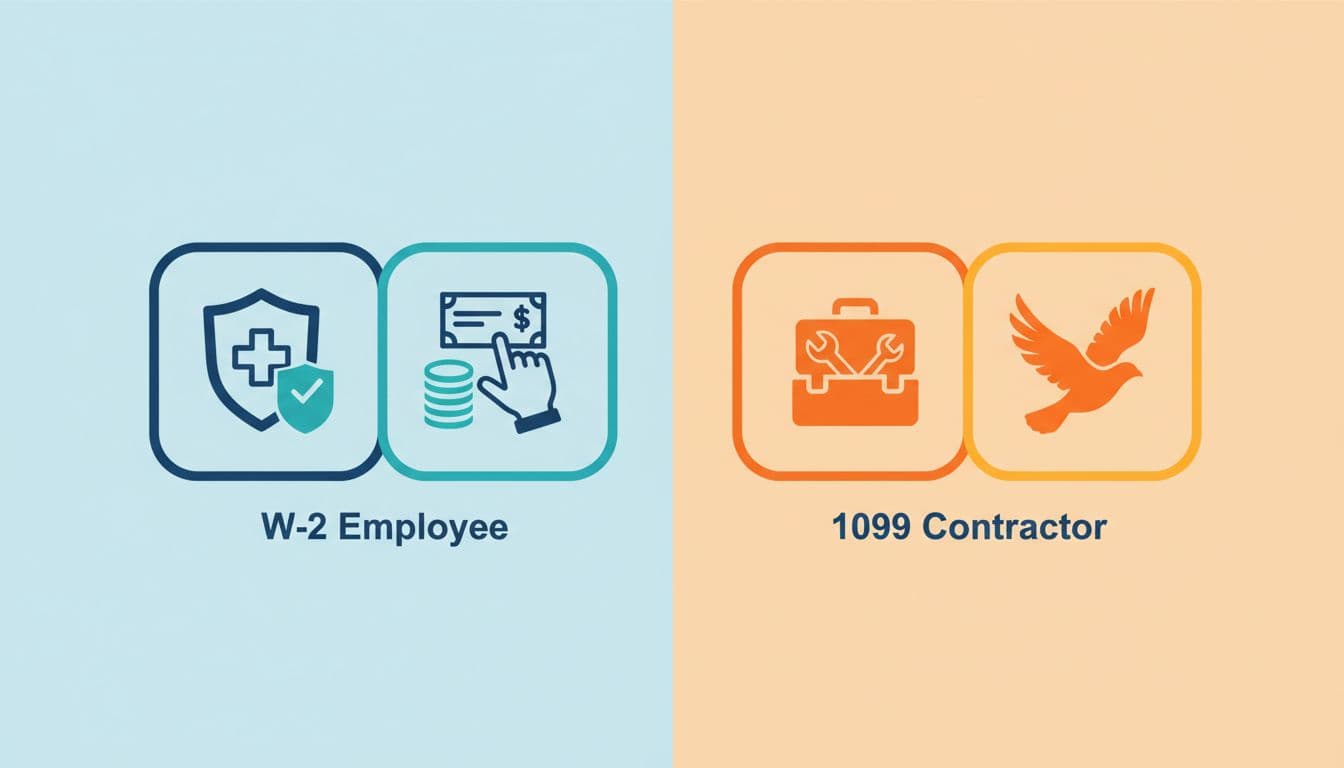
Here is the quick side-by-side view.
| Issue | 1099 contractor | W-2 employee |
|---|---|---|
| Work control | Usually sets methods and schedule | Business directs day-to-day work |
| Taxes | No regular payroll withholding by payer | Employer withholds and pays payroll taxes |
| Tools and costs | Often uses own tools and covers own costs | Business often provides tools or reimburses costs |
| Benefits | Usually none | May get benefits, policies, paid time off |
| Year-end form | Usually 1099-NEC | W-2 |
| Florida impact | Usually not part of employee payroll setup | Wages usually tie into payroll and Florida reemployment tax |
The table helps, but it is not a shortcut. A person can use their own truck and still be an employee if you control the work. On the other hand, a skilled specialist can work on your site and still be a true contractor if they run an independent business with multiple clients.
Also, do not confuse the form with the status. A 1099 is a reporting form, not a permission slip. A W-2 is the result of an employee relationship, not the thing that creates it.
If a worker is properly classified as a contractor, you still need clean year-end reporting. This Fort Myers 1099-NEC and 1099-MISC filing guide covers that side. If the worker is an employee, your year-end forms shift to payroll reporting and the Fort Myers W-2 and W-3 filing checklist becomes the better reference.
Red flags that may point to misclassification
Most problems do not start with fraud. They start with drift. A business hires a contractor, then slowly treats that person like regular staff.
Common Fort Myers examples include a helper who follows your daily route, an office admin paid as "contract labor" every Friday, or a salon assistant who works your hours under your rules. Calling the pay contract labor does not decide the issue.
Watch for these red flags:
- Set hours and fixed schedules : You tell the worker when to start, stop, and take breaks.
- Detailed training : You teach your process step by step and expect the same method every time.
- One-client dependence : The worker earns most or all income from your company.
- Business email and systems : The person is built into your team and daily operations.
- Ongoing work with no real end date : The role feels permanent, not project-based.
- Little financial risk : You cover costs, provide tools, and pay the same amount regardless of results.
Another common trap is convenience. Paying weekly, paying by the job, or paying through an app does not turn an employee into a contractor.
These issues matter because misclassification can affect payroll taxes, overtime exposure, workers' compensation questions, and Florida unemployment reporting. In other words, a 1099 can save time up front and create cleanup later if the facts do not support it.
What Fort Myers employers should do when they're unsure
When the answer is not obvious, slow down before the first payment. That pause is cheaper than fixing forms after the fact.
Start with the real facts, not the paperwork. Write down who controls the schedule, who provides tools, whether the worker can take other clients, and whether the role is tied to your main business. Then compare those facts to the IRS test. Keep a short memo in the file showing why you made the call.
Next, match your process to the result:
- If the role looks like employment , move it into payroll from day one. Use a solid onboarding process, including this new hire payroll forms checklist.
- If the role looks like a contractor arrangement , collect a W-9 before payment and keep invoices, agreements, and proof the worker runs an independent business.
- If the facts are mixed , do not rely on the contract alone. Review the relationship with your tax advisor or employment counsel.
- If you want an IRS determination , Form SS-8 is the formal route, though it can take time.
- Re-check long-term contractors every year , because a role can change as your business grows.
Do not wait until January to review workers you have paid all year. A quick midyear or year-end review is often enough to catch a role that started as a project and turned into a job.
Bottom line for small business owners
For Fort Myers employers, 1099 vs W-2 is a facts-and-relationship question, not a preference question. The IRS rules have not changed for 2026, and the DOL proposal is still only a proposal as of March 2026. Review how each worker actually works, document your reasoning, and fix gray-area roles before year-end. This article is general information, not legal or tax advice, but one careful review now can save a lot of trouble later.