Cash Reserve Calculator: Set a Target Your Business Can Use
A full sales calendar can still leave your business short of cash. Bills, payroll, loan payments, and tax due dates don't wait for an invoice to clear.
A cash reserve calculator turns that uncertainty into a practical dollar target. Instead of guessing how much should stay in the bank, you can set aside enough to keep essential operations moving through a slow month or an unexpected disruption.
The right number starts with clear records and a definition of what the reserve must cover.
Use a Cash Reserve Calculator to Find Your Starting Number
A cash reserve is money your business holds for necessary operating costs when normal cash inflows fall short. It gives you time to collect receivables, replace equipment, recover from a storm, or ride out a seasonal dip without making rushed decisions.
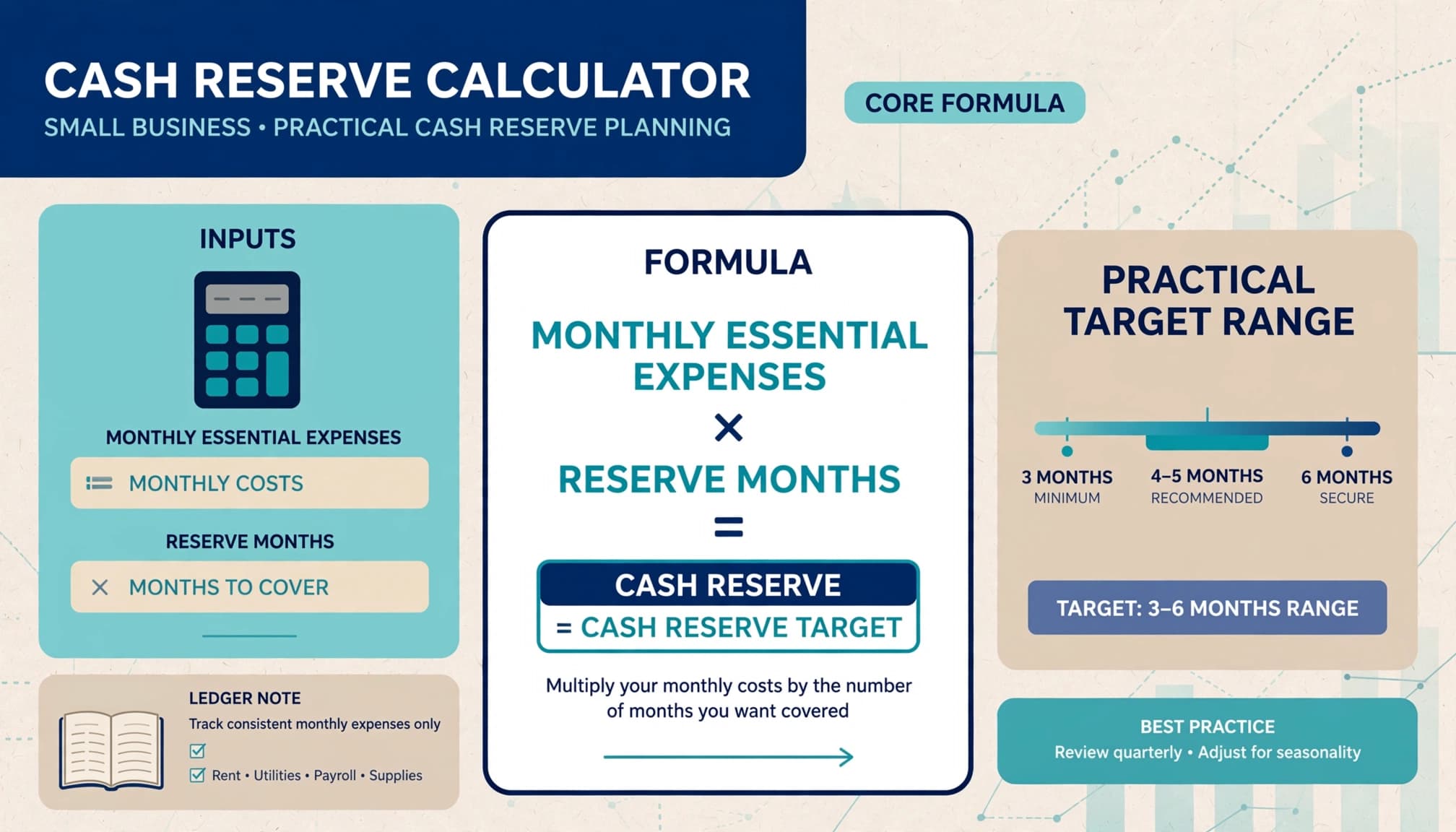
The basic cash reserve calculator formula is simple:
Monthly essential cash outflows x number of reserve months = operating cash reserve target
The difficult part is deciding which costs are essential and how many months of coverage fit your business.
Add the cash expenses that keep the doors open
Start with recurring payments your business must make to remain open. Use actual cash outflows from recent reconciled bank activity, not a rough estimate from memory.
Common items include:
- Payroll, payroll taxes, and necessary contractor payments.
- Rent, utilities, insurance, software, phone, and internet.
- Required loan and equipment payments, including principal.
- Minimum inventory purchases or supplies needed to fulfill existing work.
- Merchant fees, maintenance contracts, and essential professional services.
Owner draws may belong in the calculation if your household relies on business cash. However, separate your personal living needs from the amount required to operate the company.
Use several months of records, then account for annual costs such as insurance renewals, licenses, and repairs. The IRS explains the importance of retaining records that show business income and expenses in its small-business recordkeeping guidance.
Pick a reserve period that matches your risk
A one-month reserve may help a stable service business with predictable recurring revenue. Yet a business that depends on large projects, tourism, inventory, weather, or a few major customers often needs more time.
Start with a range of one to three months of essential expenses . Then move toward three to six months if income swings widely, you carry fixed overhead, or it would take time to replace lost revenue.
A reserve target should reflect the time needed to recover cash flow, not a number that sounds impressive.
Keep Operating Reserves Separate From Other Money
One bank balance can hold several kinds of money. Treating all of it as available cash creates trouble, especially when a profitable month makes the account look healthier than it is.
Use separate savings accounts or clear categories in your books. The labels matter less than knowing what each dollar is for.
Operating cash reserve versus profit
Profit is the amount left after revenue exceeds expenses over a reporting period. It is an accounting result. It may already be tied up in accounts receivable, inventory, debt payments, owner distributions, or future obligations.
An operating reserve is cash that remains available for essential business spending. A company can report a profit and still lack enough cash to cover next week's payroll.
For that reason, don't calculate a reserve from net profit. Use the actual cash costs needed to keep operating. A monthly cash flow forecast for small businesses helps reveal when deposits and payments will land.
Tax funds and emergency savings have different jobs
Tax money is not operating reserve money. Sales tax collected from customers, payroll tax withholdings, and estimated income tax funds belong in their own category. Spending those dollars on rent or inventory can create a painful shortfall later.
Self-employed owners can review payment responsibilities through the IRS self-employed tax center. Your tax amount depends on entity type, income, deductions, payroll, and prior payments, so use estimates from your tax professional rather than a generic percentage.
Emergency savings are separate, too. An emergency fund may cover a major uninsured loss, extended closure, or large repair. Your operating reserve covers ordinary business obligations during a temporary cash gap. Some businesses keep both, plus a dedicated tax account.
Build the Number With a Worked Example
Suppose a small design and print shop reviews six months of reconciled transactions. The owner identifies these essential monthly cash outflows:
| Essential cash expense | Monthly amount |
|---|---|
| Payroll and payroll-related costs | $7,500 |
| Rent and utilities | $3,000 |
| Software, phone, and insurance | $1,200 |
| Loan payment | $800 |
| Required materials and delivery costs | $2,500 |
| Essential bookkeeping and services | $500 |
| Total monthly essential outflows | $15,500 |
The business has steady commercial clients but occasionally waits 45 days for larger invoices to be paid. A two-month target is a reasonable first goal.
$15,500 x 2 months = $31,000 operating cash reserve target
That target does not include the owner's income-tax set-aside, sales tax payable, or money reserved for replacing a large production machine. Those amounts need their own buckets.
Turn a large target into a workable saving plan
A $31,000 target may feel out of reach if the current reserve is $8,000. The gap is $23,000. Rather than pulling money randomly from each month, set a repeatable funding rule.
For example, the owner could move $1,500 to the reserve after each month-end close and add half of any collection that arrives earlier than expected. At that pace, the business makes steady progress without treating the reserve as an afterthought.
A cash reserve calculator is most useful when updated from real books. Reconcile accounts each month so transfers, processor deposits, and outstanding checks do not distort the available balance. A monthly bank reconciliation checklist can keep those figures reliable.
Choose a Practical Target Range
There is no single reserve number that fits every small business. The appropriate range depends on fixed costs, customer concentration, payment timing, access to credit, and the owner's tolerance for risk.
Use this as a planning guide, then adjust it for your circumstances.
| Business situation | Starting operating reserve target |
|---|---|
| Stable revenue, low fixed costs, quick customer payments | 1 to 2 months |
| Established business with regular payroll or inventory needs | 2 to 3 months |
| Seasonal sales, project-based work, or slow-paying clients | 3 to 6 months |
| High fixed costs or limited access to financing | 3 to 6 months or more |
The table is a starting point, not a rule. A business with one large customer may need more cash than a similar-sized business with hundreds of smaller recurring customers.
Set a floor and a stretch target
Use two numbers rather than one. Your floor is the minimum balance that should stay untouched except for a genuine operating shortfall. Your stretch target is the amount that provides more breathing room.
For the print shop, the owner might set a $15,500 floor and a $31,000 stretch target. Once the account reaches the floor, day-to-day decisions become less pressured. The higher goal can then grow during stronger months.
Review whether the reserve is held in an insured business savings account that remains easy to access. Money invested in long-term assets or tied up in a certificate with an early withdrawal penalty may not be available when you need it.
Adjust for Seasonal or Volatile Revenue
Seasonal businesses need a reserve that reflects the calendar, not an annual average. A Southwest Florida business may see revenue shift with tourism, hurricane season, summer staffing, or customer demand.
Start by mapping monthly sales and essential cash outflows for the past year or two. Then identify the period when cash is lowest, not merely when revenue is lowest. A large invoice due during a quiet month can create more strain than a modest sales decline.

Build reserves during the strong months
When peak-season cash arrives, allocate it before it disappears into routine spending. Fund tax obligations, upcoming annual bills, and the operating reserve based on your forecast.
For example, a landscaping business may collect most of its cash during busy months but still face rent, equipment payments, and insurance year-round. Its reserve should cover the cash gap that occurs before demand returns.
Seasonal budgeting in QuickBooks Online can help place irregular costs in the months when they are due. Update the plan when staffing, vendor terms, prices, or customer payment habits change.
Use a rolling forecast, not a static budget
A budget estimates revenue and expenses. A cash forecast shows when money is expected to enter and leave your account. Both are useful, but the forecast tells you whether your reserve could drop below its floor next month.
Review the next 8 to 13 weeks each month. Include unpaid invoices by expected payment date, payroll, tax payments, loan drafts, vendor bills, and planned owner draws. If the forecast shows a shortfall, cut discretionary spending early or follow up on receivables before the problem becomes urgent.
Avoid Common Cash Reserve Mistakes
Small errors in the calculation can leave a business underfunded, while an overly aggressive target can hold back money needed for planned growth. Keep the calculation useful by avoiding a few common problems.
Counting every expense as essential
Marketing experiments, optional subscriptions, owner perks, and planned expansion costs may be useful. However, they may not belong in the bare-minimum reserve calculation.
Create two versions if needed. One can show survival-level cash needs. The other can show the amount required to operate at your preferred level. This distinction makes it easier to reduce spending during a real shortfall.
Treating available credit as cash
A credit line can help, but it is borrowed money. Rates, renewal terms, lender decisions, and existing debt can all affect access. Do not reduce your cash reserve target simply because a credit line exists.
Also, avoid rebuilding the reserve only after an emergency. Make transfers part of normal cash management. When revenue rises, check whether essential costs and tax obligations rose with it.
Forgetting to review the target
A reserve amount set two years ago may no longer cover current payroll, rent, insurance, or vendor costs. Review it at least quarterly and after major changes, such as hiring, a new lease, debt refinancing, or a large customer win or loss.
Clean books make that review faster. The IRS offers a guide to business expense resources that can support better expense classification and recordkeeping.
A Cash Target That Supports Better Decisions
A practical reserve is based on the cash your business must spend, the time it takes to recover from a gap, and the obligations that cannot be delayed. It is separate from profit, tax funds, and long-term emergency savings.
Start with a realistic cash reserve calculator target, fund it in steady increments, and revisit it as your business changes. A clear reserve balance gives you more options when sales, payments, or costs do not follow the plan.